The
British Cave Research Association held its Spring Field Meeting at the British
Cave Monitoring Centre,
There
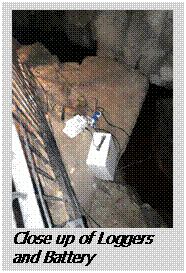
was a trip into the cave to see data loggers and collect data for examination
in the afternoon. The session was run by Professor John Gunn and Dr Andi Smith.
They have both spent some time setting up the cave as a National
Cave Monitoring Centre to be used by anyone who has an interest in collecting
and analysing data from caves. They have the full support of
In the morning there were a series of talks about collecting
data from caves, while the afternoon session was taken up by a trip into
Morning Session
John started off the morning with a brief introduction and then
Andi gave a detailed talk on why monitoring caves is useful science in relation
to climate change. Cave monitoring may be broken down into three main sections.
1.
External climate: Rainfall amount / chemistry, air temperature,
soil temperature and CO2
concentration.
2.
Cave climate: Air temperature, CO2
concentration, humidity.
3.
Karst and cave hydrology: flow paths, speleothem drip rates,
water chemistry.
His
talk was based around his PhD thesis conducted in a cave in Matienzo,
One
particularly interesting finding was that there was a big change in the level
of carbon isotope at around a date corresponding to just before 1557. His
hypothesis was that it was linked to a historical event. Until that time the
Matienzo area was heavily wooded and the trees were cleared around that time to
provide fuel in the ports to the north for the production of cannonballs for
the Spanish navy (Spanish Armada).
The
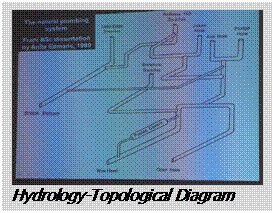
next session presented by John was on the limestone hydrology of the Buxton
area. John showed a series of maps, photos and diagrams explaining this. There
are a series of sinks to the west and south of
He explained how the
underground hydrology relates to the local geology, especially the orientation
of the syncline and anticline axes.
Andi and John discussed how cave monitoring has been covered
across the world in a number of sites (see the Cave Monitoring Database
website. https://cave-monitoring.org/) but the
1.
Cave monitoring is fundamental to supporting a range of
cave based investigations: hydrology, palaeoclimate, biological….
2.
The most robust cave science projects have long term "cave
climate" data to support their findings.
3.
It is becoming increasing difficult to set up and maintain cave
sites due to funding restrictions.
4.
There is a serious lack of continuous, long term data from
British caves.
Funding for the monitoring centre has come from BCRA, Buxton
Civic Association and Gemini Tinytag who have provided most of the loggers used
in the cave. Tinytag data loggers are cheap, made in the
Afternoon Session
In
the afternoon we split into two groups and swapped over between two activities.
1.
Trip into
2.
Session in the data centre located next to the cave entrance.
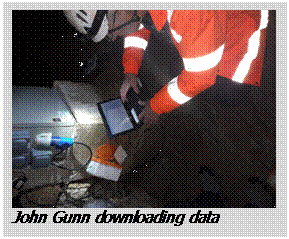
Here is the computer that collects and stores all the data logging information
and we were able to look at this and download data. This data is available on
the BCRA website.
Finally
we all came back together for a discussion and downloaded the data from the
CREG equipment and compared it with similar over the same time period from the
Tinytag loggers. This showed up a few issues with the CREG loggers.
A
thoroughly enjoyable day. Thanks for organising John and Andi.
Andy
Hall