Across
Europe Underground
 Chapter 1: The Empire
of the Dead
Chapter 1: The Empire
of the Dead
Being
a short description of curiosities encountered on a Grand Tour of the Continent
by the Incontinent

On the corner of the Avenue du Colonel
Henri Rol-Tanguy, in the Place Denfert Rocherau, in the district of
Montaparnasse, close to the Sorbonne in the city of Paris, there stands a
humble green cast iron booth opposite the entrance to the Metro station. Like the station, it is clearly a product of
the Belle Epoque. It looks like a public
toilet. Curling away from it, round the
corner, past the great statue of the Belfort Lion, back towards the SNCF
station is a long queue of people from all the ends of the globe. Even one or two Parisians are there. They are
attempting to look bored. The booth is
not a public toilet.
Paris is built on limestone. Or rather, Paris is built of limestone on
ground that used to have limestone in it.
Nowadays, as the official guide says, it is built on Swiss Cheese. Underneath Paris is a series of interlinked
underground quarries, a network of passages over 300 km long, from which the
city above has been constructed. From
Limestone on the Left Bank, to gypsum under the hills of Montmartre (hence
Plaster of Paris), all of the glittering city rests on stacks of deads and
unstable old columns no more than 30m below the surface. Have you ever wondered why there are no
skyscrapers or high rise blocks in the centre of the city? Since the mid-eighteenth century, this has
lead to a rather predictable problem.
Every so often, a building would suddenly become its own basement. Even the famously hands off French monarchy
felt that this was rather unacceptable, and, after swiftly relocating from the
Palace of the Louvre to Versailles, which is rather comfortingly located on
good solid sandstone, set up an office, the Inspector of Quarries, to prevent
similar events. These people patrolled
and mapped the tunnels and workings, the abandoned and the working, to ensure
the safety of the walls and the world above.
To keep track of the tunnels on the city map, they named the passages
and junctions after the names of the streets above, giving the place the feel
of an underworld in a Neil Gaiman novel.
Now, two other events shortly occurred in the Overworld, which changed
the slow and quiet pace of the quarries.
Firstly, the French decided to reduce the height of the existing
political elite by about 200 millimeters each, and in a truly unconnected
phenomenon, began to run out of spaces in the graveyards.
It must be admitted however, that
Napoleon Bonaparte was also about to begin another protracted exercise in job
creation for the grave diggers of Europe.
So, in the spirit of Revolutionary
Enlightenment, the savants of Paris considered how to clear the insanitary and
disease ridden graveyards of the Ancien Regime, and replace them with clean,
hygienic and progressive housing for the Sons (and Daughters, of course) of the
Revolution.
Which eventually brings us back to
the queue in the Place Donfert-Rocherau. Fiona and I stood patiently in line,
working our way towards the green booth that looks like a public toilet. Slowly the booth consumed people , none of
whom emerged again, and we moved forwards.
Behind us the queue grew, now stretching out of sight, maybe working its
way past Austerlitz, and on past Jena, all the way back to Stalingrad. Eventually we entered the small open air
courtyard in the cast iron booth, and spoke to a little old man in a grey
warehouse coat. He took our Euros, and
we started down the Spiral Stairs.
Yes, Spiral
Stairs. Stop snickering at the back, I
know who you are, and can hear you. Yes
Grey and Martin, I am talking to you.
Yes there is a continuous black line painted on the roof to prevent
people getting lost in the passages. Yes
there are signs at every junction. Why
is that funny?
Rather appropriately, the passages
from the entrance are shaped like a traditional coffin level. Every hundred metres, you come across a stone
engraved with a name and a date. You
could call this the first sign of memento mori, because it is the name of a
dead man. It is the name of a long dead
Inspector of Quarries, and the date on which he inspected that stretch of
passage. Suddenly, after passing a
series of junctions and bends, you come on a gateway, clearly inspired by
Napoleons recent efforts to spread Revolutionary Enlightenment to Egypt.

The inscription reads:- “Stop, here
is the Empire of the Dead” – note the
black line to guide the tourists. This
has been here since the early 19th century and not installed
especially for the Authors visit
Rolling back the years again, to the
Overworld, the decision was taken to empty the graveyards of the cities
churches, to clear away the source of disease and corruption and to remove all
the remains of the previous occupants. A
section of the Underworld was to receive new permanent, if somewhat quiet,
residents. The refugees huddled waiting
in their quiet earthen encampments for admission to the Kingdom of Heaven, were
forcibly relocated to new holding areas, unfortunately somewhat closer to the
Kingdom of Hell than they were hoping.
From the very first day, they were to be housed in scientific, and
artistic, anonymity.
The Comte and the Cobbler would forever rub temples
together in silence. No singular resting
place awaited them, but an arresting composition of femurs and skulls, scapulas
and pelvises, carefully curated designs for the edification of the new
bourgeois gentry. This practice of
maintenance and rearrangement continues right to the present day.
Of course, not all were savants,
interested in the anatomical variations, or poets reflecting on human
mortality. Parties were held in which
much wine was drunk and ladies shrieked
at macabre stories and pranks were played, usually with a view to ending up
inside crinolines. As time wore on, and
social attitudes changed, the authorities began to officially take notice and
the wild times came to an end.
Still, the pull of the Underworld
continued, and the visitors kept coming.
The lighting changed from candles, to gas lights and again to strings of
electric light bulbs. The queues
continued to grow along the Place. But still,
there was the real danger of the ancient mines collapsing from the weight of
the growing city above. The present
danger mainly arises from old bell chambers, aven-like cavities left from the
early mining days
They are still there in places as you
walk round the passageways, great bottle shaped voids heading up towards the
surface, buttressed by soaring arches of masonry to slow down their inevitable
collapse.

Of course, not all were savants,
interested in the anatomical variations, or poets reflecting on human
mortality. Parties were held in which
much wine was drunk and ladies shrieked
at macabre stories and pranks were played, usually with a view to ending up
inside crinolines. As time wore on, and
social attitudes changed, the authorities began to officially take notice and
the wild times came to an end.
Still, the pull of the Underworld
continued, and the visitors kept coming.
The lighting changed from candles, to gas lights and again to strings of
electric light bulbs. The queues
continued to grow along the Place. But still,
there was the real danger of the ancient mines collapsing from the weight of
the growing city above. The present
danger mainly arises from old bell chambers, aven-like cavities left from the
early mining days
They are still there in places as you
walk round the passageways, great bottle shaped voids heading up towards the
surface, buttressed by soaring arches of masonry to slow down their inevitable
collapse.
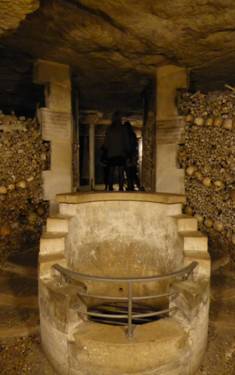
On through the quiet stacked remains
of disarticulated skeletons you progress.
Some alcoves bear the memorial plaques, details of the churchyard where
this collection has come from, and a simple date. Others recall specific details, victims of
riots during the height out into a
chamber, still walled with bones, but in the centre of which is a low wall
around a grille topped shaft – The Well of Lost Souls. Despite the Romantic and melancholy name, it
is a remnant of the original quarries, dropping down to a lower, now flooded,
level.
Eventually, after 1100 metres of
passage, following the black line on the roof until the smell in the air
changes and you reach the foot of another stairway. A short climb brings you out into the warm
sunshine of a Parisian alleyway.
Where? You are not back at the
green cast iron booth but about four streets away in a quiet back street.
A short distance away is another
Empire of the Dead, of a later, more respectable and conventional persuasion,
the giant Montparnasse Cemetery.
It too has it little secrets. Beyond the staid, detached mausoleums of
civil servants, soldiers and respectable families of a disapproving middle
class rest the artists and musicians.
They may not have the superstar clout of the residents of Pere Lachaise
across the city, no Jim Morrison or Oscar Wilde to bring out the groupies, these
are the local eccentrics and characters.
You
can spend ages wandering about here, but its not a place for lively street
life. Time to rejoin the world of the
living and the physical realities of life.
Martin Fagan