Creswell
Crags
Creswell Crags
is a limestone gorge honeycombed with caves and smaller fissures on the
Nottinghamshire-Derbyshire border. Stone tools and remains of animals found in
the caves by archaeologists provide evidence for a fascinating story of life
during the last Ice Age between 50,000 and 10,000 years ago. The site is open
to the public and tours can be arranged into several of the caves. Further evidence came to light in 2003 with the discovery of Britain's
only known Ice Age rock art. On a recent trip to Nottingham with my wife I took
the opportunity to visit the site. There are nine speleological sites in the
gorge, which is in Permian magnesian (dolomitic) limestone. The caves are
located in a gorge next to the Creswell Crags Museum and Heritage Centre.
They have a very informative website and
booking for trips into the caves can be made through this. I rang up the centre
well before our visit and arranged trips into the two main cave sites so as to
make sure I got the dates I wanted.
This is the best thing to do as the visits
are strictly controlled and only run on certain days at mainly at weekends and
school holidays. I was advised to book for a late visit (3:30 pm) to Church
Cave, that contains the rock art as then we would probably be the only
visitors. This worked well and we ended up with our own guide, Janet Lee, one
of the volunteer archeologists. We also booked the main tour in Robin Hood's
Cave. This lasts for an hour and is also worthwhile as it is the site of a
number of important finds.
The caves predate the Ice Age and formed
phreatically at or below the water table and created the circular chambers seen
in Robin Hood's Cave. During the Ice Age the water table dropped and the gorge
was created, probably by melt waters from the glaciers to the north exposing
the caves. Since then at the end of the Ice Age the caves have been used by
both man and animals. The site has been a source of archeological finds since
the 18th Century and research is still going on today.
We first went round the Visitors Centre,
which contains a cafe, the inevitable gift shop and a museum with visual aids
guides you through the story of life in the Ice Age.
The newly
opened museum principally funded by the Heritage Lottery Fund, with additional
contributions from East Midlands Development Agency is very informative and has
many of the finds from the caves on display It incorporates state-of-the-art
displays, a research and library room, collection storage facilities as well as
a suite of rooms for education groups, talks and conferences. From the museum
visitors are able to walk out into the limestone gorge and tour around the
prehistoric caves. The British Museum, a major partner with Creswell Crags, is
one of several museums that have agreed to loan artefacts for display and as
part of a rolling programme of temporary exhibitions. We spent nearly an hour in here looking around in between our visits to
two of the caves.
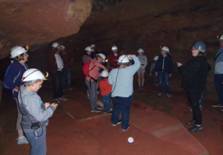
The first cave we visited was Robin Hood Cave. The guided tour takes about an hour and is
very informative. There are some sections where you have to stoop. The cave is
not lit and visitors are provided with helmets and lights. Photography is
permitted as well. This is the largest cave and lies on the south side of the
gorge almost in the middle. It has four main chambers linked by a series of
lower passages and extends into the cliff for about 50 metres.
A series of avens lead up towards the surface
and this is where a lot of the sediment in the cave originates from. Major
excavations took place in 1875-76, which removed much of the sediment in a
relatively unsophisticated way. There were many finds including the engraving
of a horse on a rib bone and a tooth from a sabre toothed cat and crude stone
tools. There were more excavations in 1889 but these were poorly documented.
From these and other more recent finds is has been shown that the cave was
occupied by Neanderthals between 50,000 – 40,000 years ago. Flint tools have
also been found near the top of the sedimentary sequence dating from humans at
the end of the Ice Age about 12,500 years ago. The most ancient sediments from
the base of the central chamber deposited about 120,000 years ago buried the
remains of hippopotamus and rhinoceros animals that lived in the Creswell
region when the climate was warmer than now.
Our second visit was guided visit to Church
Hole, famous for its prehistoric engravings. It is on the north side of the
gorge almost opposite Robin Hood Cave.
It is a narrow rift cave penetrating 60
metres back into the cliff. Just inside the gated entrance the cave has been
enlarged by erosion into a chamber. It is this area where the majority of the
recent rock art discoveries were made only a few years ago. There is another
gate restricting access to the rest of the cave and our visit ended here but we
were not disappointed. The art work was only discovered recently as the floor
of the excavated cave passage is some four metres below the metal gangway you
climb up to was the way the cave was entered over the last 100 years since the
excavations in 1875.
Refs: Creswell Crags, Inspiring Stories. (Now in Red Rose Library). www.creswell-crags.org.uk
Andy Hall




Cresswell Crags
Location Map Entrance to Church
Hole Robin Hood Cave
Main Chamber Church Hall Robin Hood Cave


Neanderthal & Human Skulls Ice age engraving of Red Deer Stag Outline of Stag