Caves in
Lanzarote
My attention was first
drawn to the possibility of caves in the island of Lanzarote, one of the Canary
Islands, off the coast of West Africa, when I was editing Caves & Caving magazine
back in the 1980's. Ever since I had it at the back of my mind to go there, so
when Sue suggested going somewhere for some winter sun in January, I suggested
Lanzarote, some four hours flight from Manchester.
It is an attractive
island with an all the year round sunny climate, lots of fine beaches and
plenty of interesting coastal and inland walks. The island is volcanic in
origin without any limestone but it does have a number of caves due to the
volcanic activity.
The best of these is a 6
kilometre long lava cave in the north of the island, the Cueva de los Verdes System.
It is not in any way green as the Spanish name suggests but named after the
family who once owned the land it is on. Its formation is the result of
eruptive activity of the La Corona volcano about 4,000 years ago. The lava tube
runs NW-SE from the volcano for 6 kilometres all the way down to the sea to
Jameos del Agua and beyond in a flooded lava tube 1,500m below the sea floor. Jameos
del Agua forms part of the Volcán and Malpaís de La Corona National
Park and it was identified as a site of scientific interest on 19 December
1994. It’s also considered as an ecologically fragile area.
Two sections are open to
the public as show caves, Cueva los Verdes and Jameos del Agua and were both
originally opened in the 1960's. In the past both caves were used as hiding
places by locals when the island was raided by pirates. Later in the 19th
Century the caves became a place to visit for European travelers and scientists
travelling around the Canary Islands. In keeping with other artistic locations
on the island the setup of the tourist section of Cueva de los Verdes the
lighting of the cave is tastefully done and little damage has been done to the
cave with the walkways being carefully placed throughout the cave. The tour of
the cave lasts over an hour through passages up to 50 metres high and twenty
metres wide. There are peculiar rock formations, lava channels, solid blocks
dragged along by the flowing lava, gypsum deposits and lava stalactites.
Lava stalactite
(lavalite) is a type of stalactite that is formed in lava tubes while lava is
still active inside. The mechanism of formation is the deposition of material
on the ceilings of caves, however with lava stalactites formation happens very
quickly in only a matter of hours, days, or weeks, whereas limestone
stalactites may take up to thousands of years.
The system is made up of
one long lava tube, sometimes on two levels, but has a number of entrances or
“jameos” These are roof collapses which gain access to the main lava tunnel.
They can be clearly seen on Google Earth. Some are near the road and easy to
find but some are up to a kilometre out in the middle of the featureless lava
field so a Sat Nav and compass are useful to locate them.
We first visited the
Jameos del Agua. This is a bit like a mini theme park created by the Lanzarote
artist César Manrique and reflects one of the cornerstones of his creative
work: “harmony between nature and artistic creation”. This is where the
lava tube finally reaches the sea. We
bought a combined ticket, which saves you a few Euros.
It is located next to the
coast and comprises at least three holes or caves, namely: Jameo Chico, Jameo
Grande and Jameo Cazuela. One of its chambers is used as a night club and
concert venue. Another has a lecture theatre built into it. One of the jameos
contains artwork and a blue and white pool. The cave continues underwater below
sea level for a nearly a kilometre.
Jameos del Agua is ecologically important as it’s home to a unique
and endemic species of tiny lobster. The blind lobster (munidopsis polymorpha), an albino and blind crab that is only one centimetre in
length. These lobsters are very sensitive to changes in the lagoon (derived from
the sea water), They are
also very sensitive to pollution and therefore, it’s forbidden to throw coins
in the water! They can be clearly seen in the main chamber below Jameo Grande clinging
to the submerged rocks, especially at high tide. The Jameos del Agua complex
also contains an interesting audio visual museum about the volcano, a cafe and
the inevitable gift shop.
Next we went on the main show cave, Cueva de los Verdes one kilometre
up the road. From a cavers point of view this is much more impressive as it has
a large lava tube much of it on two levels. It is a round trip via the two
levels lasting about an hour. We went through about a kilometre of passages and
even had to bend down through a couple of low bits. The passages are tastefully
lit and you are able to take photographs. There are peculiar rock formations,
lava channels, large holes in the floor between one level and the other and
gypsum deposits. These have been produced by water percolation from the surface
but the cave is mostly dry with a slight draught and a constant temperature of
19 degrees C. At the far end of the tourist section in the lower level is a
large concert hall. In the upper level a dammed lake has been created to give a
spectacular reflection of the passage above.
We then moved on up the road to look for other parts of the
system. These are out on the lava fields across rough terrain and you need to
take care. The first one is close to a bend in the road and easy to find, Jameos de la Puerta Falsa. Even so
it is not obvious from the roadside. It is a large hole with two lava caves
heading off in either direction. The most striking features of the caves of
Lanzarote are the size and volume of the tubes as well as prolific gypsum
deposits. Many of the huge overhanging entrances in the Monte Corona system are
used by climbers as well as cavers.
A ramp leads down the south side of
the entrance collapse. Once inside the Jameo I made my way to the tunnel on the
right , towards the sea. I knew that this part of the tunnel is a dead end,
blocked to stop access to the show cave, so after advancing by about 15 minutes
I turned round. I went into the other northward tunnel for a short distance and
a through trip to the Jameo de la Gente is possible but I
did not get that far as Sue was waiting for me in the car! There were no real
difficulties but good thick gloves and knee pads would be a good idea for any
prolonged exploration! The floor is quite dusty as well.
Beyond the ramp out of Jameo de la Gente there is another tunnel that goes straight ahead to reach the Jameo de Prendes. To get out of that
Jameo involves vertical caving with a 15 metre pitch near the entrance. Unlike
the previous tunnel there are several branches so that there are route finding
difficulties; not ideal for solo caving when nobody really knows where you are!
Searching on the internet showed that there is a local company that organises
guided through trips for both parts of the system.
Other Caves:
Some of the caves are in the Montanas del Fuego de Timanfaya
National Park where a permit is required. It has been suggested in some
reports that permits are never granted, as the infrastructure isn't in place.
Park wardens are around and easily recognisable on the lava flows. Stay on the
coastal footpaths if in doubt. However there is a multilingual bus tour around
the Park which does pass a number of lava caves and through a collapsed lava
tunnel. It is well worth the trip through this spectacular landscape.
Cueva
de los Naturalistas Comprises 1,600 m of underground tunnel and 2.1 hectares of area.
It was classified in 1994 as a Natural Monument. It is located in the protected
landscape of La Geria. Monumento Natural
de la Cueva de los Naturalistas is a protected area due to its volcanic caves
and draws unique geomorphological and scientific interest. It has several lava
tubes and is one of the most important caves of the archipelago. We did not
have time to visit this site but an easy through trip is possible. There are
Youtube videos of people doing it with hand torches!
This lava tube is located in a large lava lake formed by the
Tizalaya volcano. The large cavity has innumerable branches, forming galleries
of great beauty and has attracted scientific interest. It can be difficult to
access due to the rocky floor and lava flows. Inside you can see numerous
structures like lava fronts, side terraces and curious formations estafilitos
(solidified lava drops in clusters of more than 5 cm in length) created by
solidified lava. There are two other caves which are marked on maps of
Lanzarote. They are sea caves but are both worth a visit as they are quite
spectacular and relatively easy to get to.
Cueva del Agua: It consists of a short lava tube/sea cave leading to a blow hole. Due to its 10 metre diameter it is considered one of the largest natural pools in Lanzarote. Also known as La Olla, its isolated location between Los Cocoteros and Charco del Palo (Northeast of the island) explains its lonely and somewhat recluse state. We did not have time to visit this.
A more interesting site and easier of access is Los Hervideros. This is situated near the 4km marker on the road to El Golfo. It
has a large free car park and safely laid out paths down to a spectacular large
sea cave with several blow holes. There are great views of waves crashing up
the face of the lava and into the caves which can be viewed at different angles
from the numerous walkways. The name Los Hervideros translates to the “boiling
pots" and a visit here is worth timing with a high tide or full moon to
experience the full power of the waves crashing into the rocky cliffs. There
are winding footpaths throughout the cliff top here with lots of peep holes
down to the sea below.
Andy Hall
References:
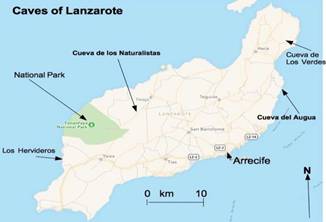
Map of Lanzarote

Cueva los Verdes main passage
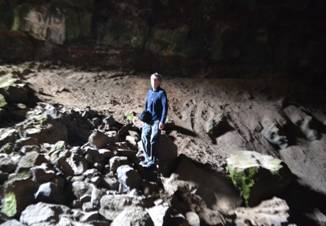
Inside Jameos de la Puerta Falsa
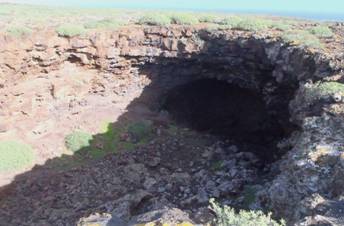
Jameos de la Puerta Falsa lower section
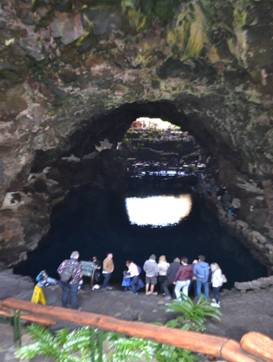
Jameos del Agua
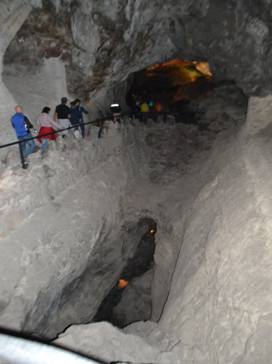
Cueva los Verdes multi levels